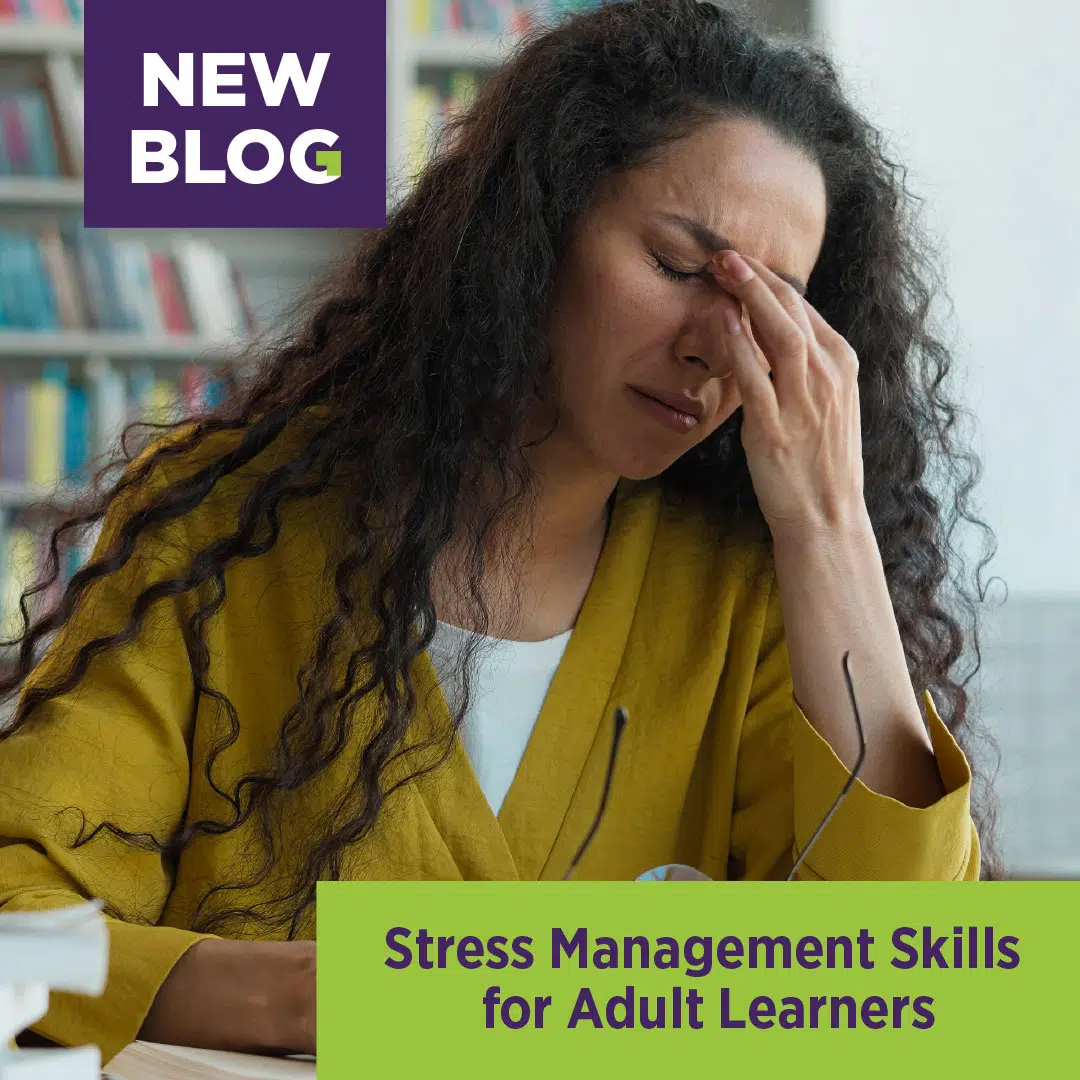
Stress Management Skills for Adult Learners
This blog is for informational purposes only. For medical advice or diagnosis, consult a professional.
Imagine staring at a complex assignment or a mounting pile of bills. How do you feel physically? Is your heart racing? Are you clenching your jaw? Mentally, is anxiety gripping you? Does the situation feel out of your control?
This is stress. Biologically, stress is your body’s highly coordinated, systemic effort to reallocate energy to ensure survival. It is a brilliant mechanism designed to protect us from ancient predators. But it can be debilitating in a modern world where risks greet us at every turn—financial security, family and societal division, and future uncertainty.
For adult students, this stress is amplified by a “triple threat” of responsibilities. You may be balancing the needs of children or a spouse while trying to be a perfect student. You may fear your study skills are “rusty” or struggle to manage tuition alongside mortgages and childcare. Often, you are juggling a job with class schedules and homework, requiring constant, exhausting time negotiations.
How Stress Derails Your Dreams
When stressors are too intense or last too long, the body becomes overwhelmed. For the adult student, the danger isn’t just “feeling tired”; it is a systemic breakdown of the tools you need to succeed.
- Memory Impairment: High levels of cortisol (a stress hormone) can shrink the part of the brain responsible for forming new memories. You might study for four hours and retain almost nothing.
- Reduced Decision-Making: “Brain fog” makes it difficult to prioritize tasks, leading to a cycle of procrastination.
- Physical Wear and Tear: Stress diverts energy from your immune system. A simple cold can turn into a two-week illness that results in missed deadlines.
The ultimate risk is burnout. This is where stress poisons your professional productivity, causes you to withdraw from loved ones, and eventually leads to academic setbacks. You might find yourself quitting school simply because the biological “tax” on your future feels higher than the reward of the degree.
Red Flags
Watch for these signs that your stress has moved from manageable to dangerous:
- Losing interest in subjects you once felt excited to learn.
- Being exhausted all day but unable to sleep due to a “racing mind.”
- Frequent tension headaches, jaw clenching (TMJ), or digestive issues.
Note: If stress feels unmanageable or is causing physical symptoms like chest pain or chronic insomnia, it is always best to consult a healthcare professional.
Learning to Manage Stress
You are not a failure for feeling stressed; your body is doing exactly what it was designed to do. However, you can use specific “tricks” to reset your body and help it return to a state of balance.
Physiological Techniques
To stop the stress response, you need to send a biological signal to your brain that the threat has passed. The key is stimulating the vagus nerve, which runs from your brainstem to your heart and lungs. Because the vagus nerve passes through the throat and diaphragm, you can stimulate it using your breath and vocal cords.
- The “Sigh of Relief”: This is one of the fastest biological ways to lower your heart rate. Inhale deeply through your nose, take a second sharp inhale at the very top to fully inflate the lungs, and exhale very slowly through your mouth.
- Humming or Chanting: The vibration of a low-pitched “Mmm” physically stimulates the vagus nerve in the neck. This is why meditation is often suggested for stress relief.
- Cold Water Immersion: Splashing ice-cold water on your face triggers a reflex that immediately slows the heart rate and redirects blood to the brain.
Cognitive & Lifestyle Techniques
Reframing how you process information is equally vital to managing stress. Journaling can help you identify the underlying causes of your stress and approach hurdles with curiosity. Asking, “What can I learn here?” transforms fear into a challenge. Observing your own stress reactions without judgment can help you understand personal triggers and develop techniques to overcome them.
These mental shifts can also be supported by lifestyle anchors. While they seem basic, they can prevent stress from becoming chronic:
- Physical Activity: Metabolizes stress hormones and increases endorphins (the body’s “feel-good” chemicals)
- Sleep: Improves emotional regulation and decision-making capacity
- Social Connections: Releases oxytocin, which acts as a natural buffer against stress.
Targeted Strategies for the Busy Student
Because your time is a finite resource, here are some other tactical techniques that busy students can use to reduce stress:
- The “Cook Once, Eat Twice” Strategy: Meal prepping or automating errands can save 3–5 hours a week for studying.
- Weekly Planning Sessions: Spend 30 minutes every Sunday reviewing class syllabi and family schedules to prevent “crisis mode.”
- The “Closed-Door” Policy: Set firm boundaries. Treat study blocks like a shift at work—uninterrupted and non-negotiable.
- “In-Between” Learning: Use your commute to listen to recorded lectures. This “stacks” responsibilities so you don’t feel like you are losing time.
Ultimately, managing stress as an adult learner is about moving from a state of survival to a state of performance. By recognizing biological “red flags” and employing physiological and cognitive tools to manage stress, you aren’t just getting through your classes; you are protecting the very future you’re working so hard to build.
Looking for more resources on how to manage stress in your life? Hear from a licensed professional clinical counselor about stress and self-care, in our Let’s Chat Webinar: Stress-Less and Self-Care. Watch the replay now!
Share this article!